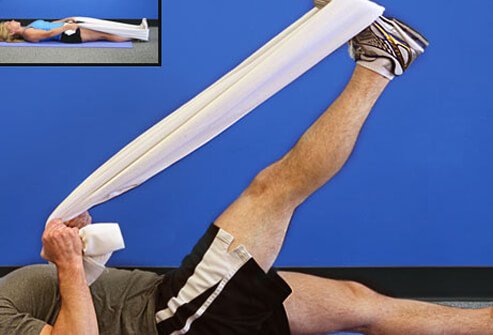
Hamstring Stretch
Stretching keeps you flexible and improves your range of motion, or how far you can move your joints in certain directions. It also helps you lower your odds of pain and injuries.Always warm up with a 5-minute walk first. Lie down when you're ready to stretch your hamstring. Loop a bed sheet around your right foot. Use the sheet to help pull the straight leg up. Hold for 20 seconds, then lower the leg. Repeat twice. Then, switch legs.
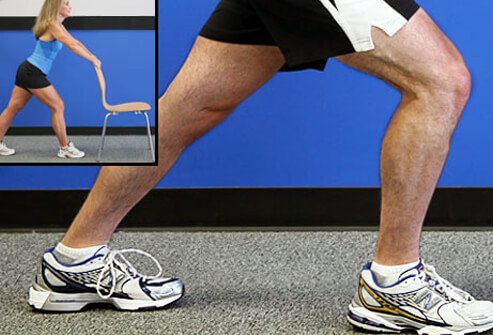
Calf Stretch
Hold onto a chair for balance. Bend your right leg. Step back with your left leg, and slowly straighten it behind you. Press your left heel toward the floor. You should feel the stretch in the calf of your back leg. Hold for 20 seconds. Repeat twice, then switch legs.For more of a stretch, lean forward and bend the right knee deeper -- but don’t let it go past your toes.
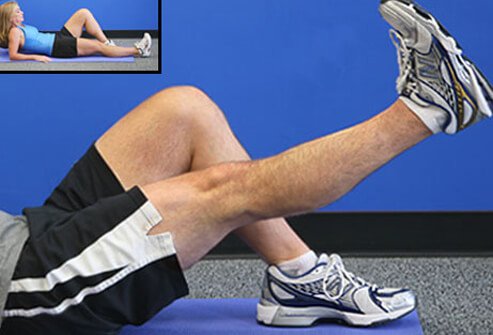
Straight Leg Raise
Build muscle strength to help support weak joints.Lie on the floor, upper body supported by your elbows. Bend your left knee, foot on the floor. Keep the right leg straight, toes pointed up. Tighten your thigh muscles and raise your right leg.Pause, as shown, for 3 seconds. Keep your thigh muscles tight and slowly lower your leg to the ground. Touch and raise again. Do two sets of 10 repetitions. Switch legs after each set.
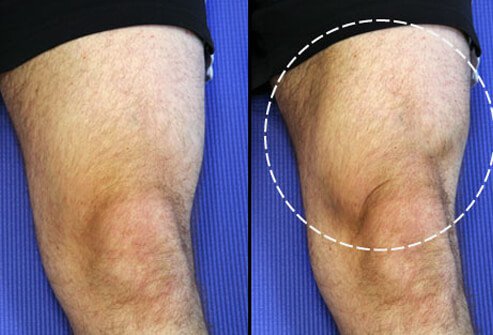
Quad Set
Is the straight leg raise too tough? Do quad sets instead. With these you don’t raise your leg. Simply tighten the thigh muscles, also called the quadriceps, of one leg at a time.Start by lying on the floor. Keep both legs on ground, relaxed (left photo). Flex and hold left leg tense for 5 seconds (right photo). Relax. Do two sets of 10 repetitions. Switch legs after each set.
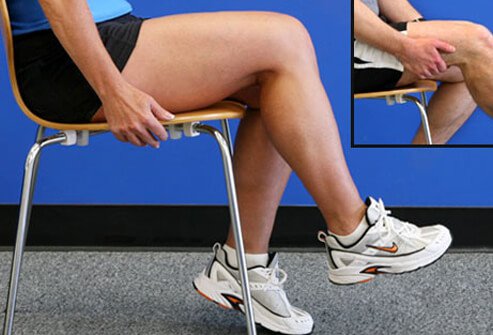
Seated Hip March
Strengthen your hips and thigh muscles. It can help with daily activities like walking or standing up.Sit up straight in a chair. Kick your left foot back slightly, but keep your toes on the floor. Lift your right foot off the floor, knee bent. Hold the right leg in the air 3 seconds. Slowly lower your foot to the ground. Do two sets of 10 repetitions. Switch legs after each set.Too hard? Use your hands to help lift your leg.
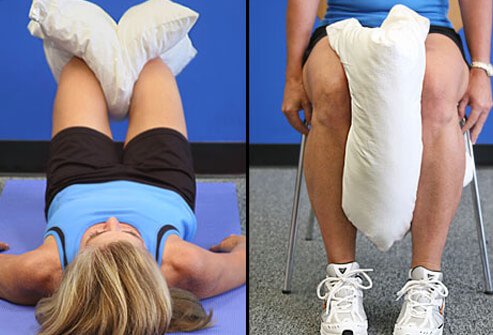
Pillow Squeeze
This move helps strengthen the inside of your legs to help support your knees. Lie on your back, both knees bent. Place a pillow between the knees.Squeeze your knees together, squishing the pillow between them. Hold for 5 seconds. Relax. Do two sets of 10 repetitions. Switch legs after each set.Too tough? You can also do this exercise while seated.
Heel Raise
Stand tall and hold the back of a chair for support. Lift your heels off the ground and rise up on the toes of both feet. Hold for 3 seconds. Slowly lower both heels to the ground. Do two sets of 10 repetitions.Too tricky? Do the same exercise while sitting in a chair.
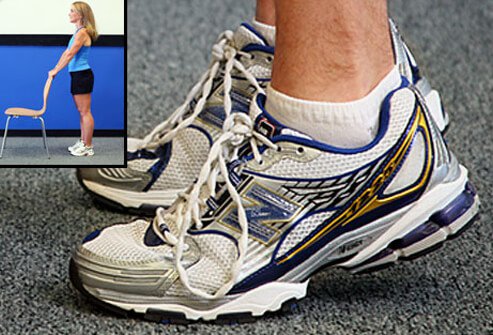
Note: Before you start strength training, ask your physical therapist or doctor what exercises are best for you. And ask how to safely perform strength exercises so as not to get hurt. Exercise books and videotapes can also show you how to perform strength exercises correctly.
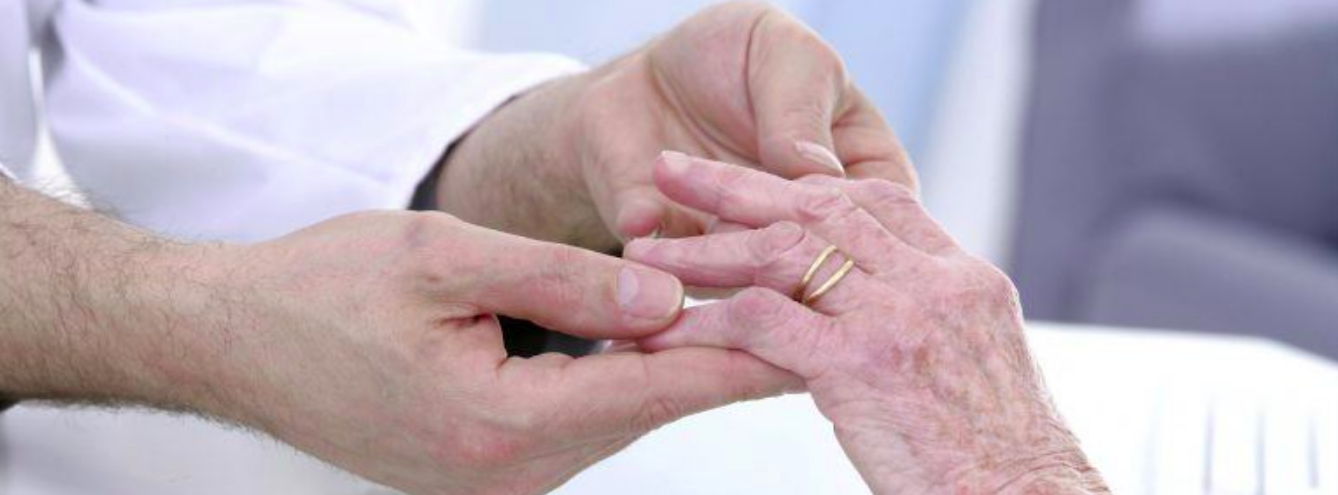
Osteoarthritis is a joint inflammation
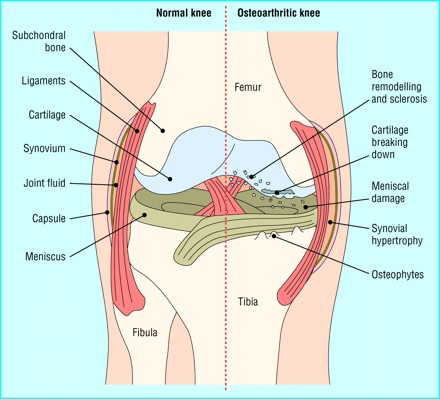
that results from cartilage degeneration.Degenerative joint disease is another name for osteoarthritis.Osteoarthritis can be caused by aging, heredity, and injury from trauma or disease.The most common symptom of osteoarthritis is pain in the affected joint(s) after repetitive use. Other osteoarthritis symptoms and signs includeswollen joints,joint stiffness,joint creaking, andloss of range of motion.
There is no blood test for the diagnosis of osteoarthritis.The goal of treatment in osteoarthritis is to reduce joint pain and inflammation while improving and maintaining joint function.
What is osteoarthritis? Readers Comments 11 Share Your Story
Osteoarthritis (OA) is a form of arthritis that features the breakdown and eventual loss of the cartilage of one or more joints. Cartilage is a protein substance that serves as a "cushion" between the bones of the joints. Among the over 100 different types of arthritis conditions, osteoarthritis is the most common joint disease. OA occurs more frequently as we age. Before age 45, osteoarthritis occurs more frequently in males.
After 55 years of age, it occurs more frequently in females. In the United States, all races appear equally affected. Hand osteoarthritis, hip osteoarthritis, and knee osteoarthritis are much more common in seniors than younger people. A higher incidence of osteoarthritis exists in the Japanese population, while South-African blacks, East Indians, and Southern Chinese have lower rates. Osteoarthritis is abbreviated as OA or referred to as degenerative arthritis or degenerative joint disease (DJD).
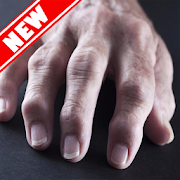
Osteoarthritis commonly affectsthe hands,feet,spine, andlarge weight-bearing joints, such as the hips and knees.Osteoarthritis usually has no known cause and is referred to as primary osteoarthritis. When the cause of the osteoarthritis is known, the condition is referred to as secondary OA.







For those who are hooked to their PCs, we got you, Sensei



Just leave a request if you need advice
Fields marked with an asterisk (*) are required.
* The information, including but not limited to, text, graphics, images and other material contained on this website are for informational purposes only. It is not intended to be a substitute for professional medical advice, diagnosis or treatment. Always seek the advice of your physician or other qualified health care provider with any questions you may have regarding a medical condition or treatment and before undertaking a new health care regimen, and never disregard professional medical advice or delay in seeking it because of something you have read on this website.